Ellen Austin-Li

poet and writer
Ellen Austin-Li
  • Home
  • Blog
  • Showcase
    • Poetry
    • Essays
    • Books
    • Select Journal Publications:
  • About
  • Events
  • Contact
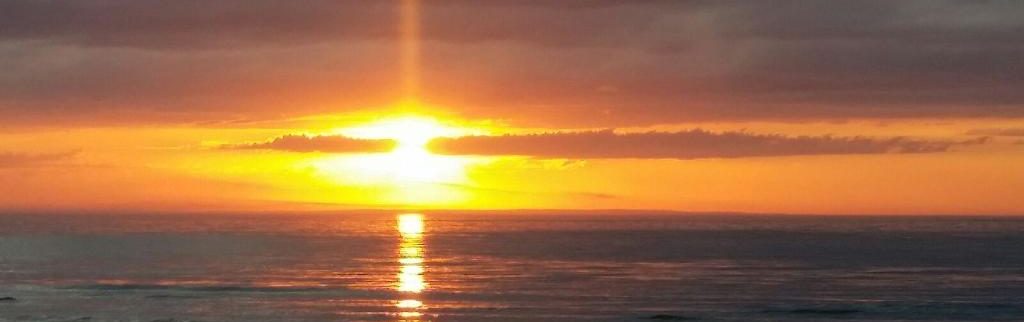
    • Solstice: Where I Begin Again

      Posted at 4:14 pm by Ellen Austin-Li, on February 28, 2020
      Winter Solstice
       
      I.
      Dark
       
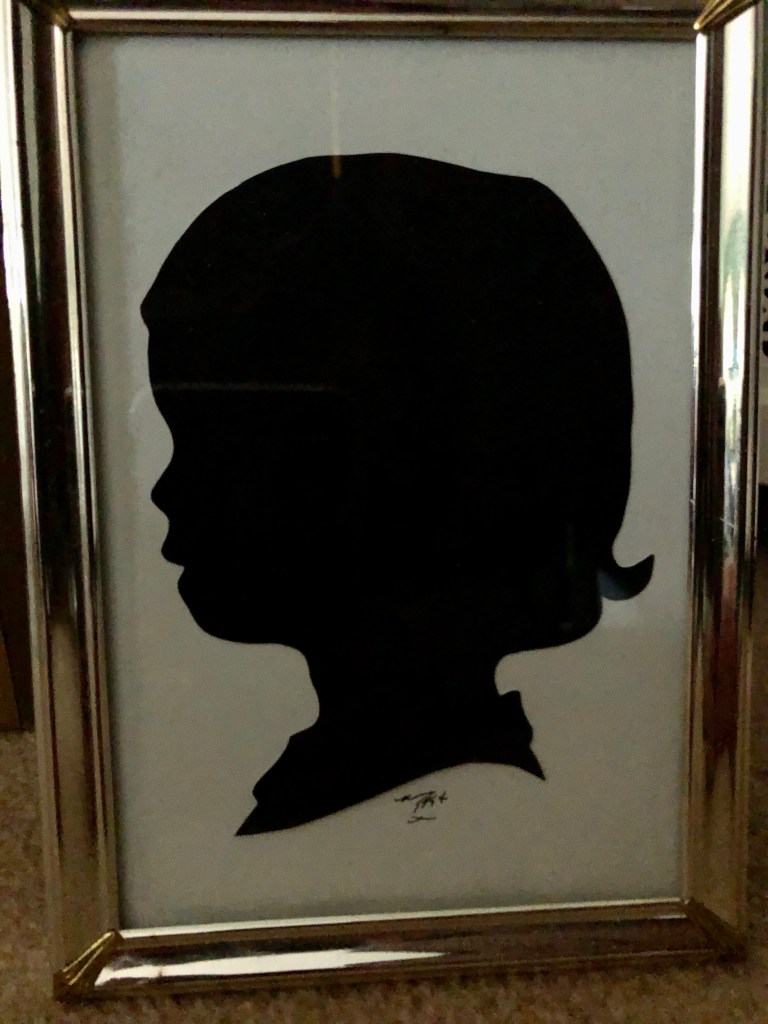
      One Christmas, my mother gifted me
      my childhood silhouette in a silver frame:
      a featureless profile in black, set against
      a white background. I recognized
      the weak chin and the errant curl flipped
      below my crown. What better self-portrait
      of youth than a faceless one, lips gapped
      as an accessory to take in more air?
      That little girl was all shadow, swallowed
      by the too-brightness around her.
      And she had no eyes — nothing to bring in
      the light right there in front of her
      as she turns away to face the coming
      of the longest night. She cannot see
      that this darkness means rebirth.
      On Winter Solstice the ancients say
      the sun is born. I wish I could cut
      an aperture in the dark form, save her
      from a lifetime of blindness.
       
      II.
      Light
       
      I open the mason jar, switch on
      the fairy lights — a string of fireflies
      animate as if it’s June and I’m capturing
      lightening bugs in the backyard.
      I screw on the metal lid and recall
      how the real ones flickered, then faded
      overnight. I lift this gift from a friend,
      unblinking, bold, brilliant: a beacon
      lit from the inside.
      And the stars start out on their cold slide through the dark.
      And the sun kicks inside the dark womb of the moon.
       
      * Italicized line from “Clear Night,” by Charles Wright

      Published in Anti-Heroin Chic, December, 2019


      Where I Begin Again

      Two months past the Winter Solstice, and I’m two months into my new life as a graduate student. Just a year ago, this plan was only a seed in my brain, but I followed the flow in a confluence of events and stumbled upon a graduate program in poetry that welcomed me into its fold: the Solstice Low-Residency MFA in Creative Writing Program at Pine Manor College. All the check marks fit into my neat little boxes—excellent faculty, exciting writers-in-residence, reasonable price, and on a woodsy campus near my beloved Boston, where so much of my history resides.

      I could not have predicted the hold poetry took on my soul. Part prayer, part meditation, poetry is a lifestyle, a life force, central to meaning-making at this developmental stage (yes, we are always in a developmental stage!) when understanding where I’ve been and how I got here occupies the mind. For me, using poetry as a tool, I step into the future. What will I leave behind? Studying the craft of poetry gives some intention to this question. I intend to gain clarity around this with each piece I write.

      There are advantages to returning to school at age 62, one of them being a pure motivation to match my written work with my intention. I’m not bogged-down by ego-driven ambition. One could say that being a relatively new writer at my age precludes any sort of notoriety. I’m in this to learn. I am in the enviable position of a woman who has already paid her dues in the workplace, has raised two sons, and finds herself with the time and the means to begin again. A friend of mine noted that most people are winding down at my age, but I’m in a different position. My progress was slowed by downed trees. I am nearly 16 years sober, but it’s been a hard-fought journey. I am most grateful to have emerged from these woods—late, but not too late, never too late—to rejoin the world.

      Disadvantages do exist in this scenario: I am often befuddled by what it is I am trying to say. I bring to every new experience a lifetime of memories and preconceived notions. Some may call this experience wisdom, but sometimes it’s difficult to wade through the committee in my head to distill the center in a poem. Psychologists call the ability to weed through information to find what’s important, “saliency determination;” I must have a deficiency there, now that I’m “awake.” Everything seems important to me. Writing poetry forces clarity—an exercise, or rather a practice, in awareness. In this way, composing poems fits into the framework of recovery: it is a significant part of my spiritual life.

      I approach this work with a sense of gratitude. I’m grateful to have found, with fellow writers, an engaged community. By pursuing a graduate degree, my main hopes are continued growth and to be able to contribute, after so many years of absence, in a meaningful way. A new year, a new decade, a new life. This sun kicks inside the dark womb of the moon.

      Share this:

      • Tweet
      Like Loading...
      Posted in writing | 6 Comments | Tagged MFA programs, poetry, recovery
    • A Marriage of Differences

      Posted at 2:45 pm by Ellen Austin-Li, on December 6, 2019

      In this polarized social climate, many people of color feel a sharpening of their sense of “otherness.” (More in the poem and essay below)

      Share this:

      • Tweet
      Like Loading...
      Posted in Uncategorized | 0 Comments
    • A Marriage of Differences

      Posted at 1:22 pm by Ellen Austin-Li, on December 6, 2019
      From Riparian, Poetry, Short Prose, and Photographs Inspired by the Ohio River. Sherry Cook Stanforth & Richard Hague, editors.
      Dos Madres Press, Inc. 2019.

      Back in our Boston days, early in our courtship, my husband took me to Dim Sum in Chinatown. I had not yet experienced this authentic Chinese brunch and watched while J. waved over carts heaped with bamboo steamer baskets and lidded metal dishes. I listened while his voice, once familiar, wrapped around the soft sonics of Mandarin, asked and answered questions from a side of him I could never know. His queries were answered with nods and rapid-fire Chinese, lids lifted from the dishes about which they had clearly communicated. A cloud of steam rose before my husband’s face. He looked for a moment like the images I’d seen of mountains in remote China: an alien landscape, mysterious, shrouded in mist, unlike anything I’d seen before.

      I had no clear preconceptions about Asians before I met my husband, but perhaps this illustrates what I have heard him, in rare moments, drop into our conversations — this perception he holds that Asians are invisible. From the first time I saw him, I was drawn to his singular appearance: the way his irises, so black, make you feel as if you are falling into a well, the way his eyelids look as if they’re expertly lined with jet-black eyeliner, the perfect dark arch of his eyebrows, his soft full lips so unlike my own. To me, there was nothing common about him.  

      But, what happened that day in Chinatown lent fuel to his perception of invisibility. Just before we sat down to our first Dim Sum together, we had waited in a long line that extended out the door, down the steps onto Beech St., then wrapped halfway around the gritty block. I left J. in line to go inside to use the restroom. While looking for him when I returned, I walked past him in both directions, twice—until he grabbed my arm.

      “Oh! I didn’t see you,” I said

      “We all look alike,” J. dead-panned, really without any sort of a laugh.

      I sensed the pain behind his comment, even though I didn’t then know him well. This was one of the first times I felt the truth of another race’s experience. The memory of that day has stayed with me over twenty years later. I find myself cataloging these instances that stand out— when it is evident that we are from two distinct races, two very different cultures.

      Our differences play out in myriad ways. When our oldest son, now 22, comes home for a visit, he walks around the house, snapping his fingers and whistling. While I see joy and comfort in these mannerisms (as well as the ghost of my late father who did these same things), my husband sees a display of idiosyncrasy, a weakness that makes one stand out.

      “People will get the wrong impression of you,” my husband warns. “They’ll think you’re a lax person.” 

      As soon as my son’s hand goes to his hair while he’s making a point, my husband stops him: “People will think you’re insecure. You have to always be aware of these habits. Get rid of them.” 

      After my initial reaction, which is to think that my husband is too controlling, I stop to think about all the ways we have been taught differently. In my Caucasian upbringing, correcting a child for whistling or finger-snapping never happened (it would have been considered charming); in my husband’s Chinese childhood, parental directives on the minutia of behavior were omnipresent. Lest the reader incorrectly surmises that I am married to a harsh man, let me say that my husband tells our sons at every opportunity how much he loves them; he also hugs and kisses them daily, while I struggle to remember to do this. Do these differences have anything to do with culture, or are they behaviors specific to our particular families? Or, is my husband’s experience more directed by being a first-generation immigrant, striving to blend in, while mine is the more relaxed atmosphere of a fourth-generation family? I am not sure, but I know there are many lessons in this for me. 

      A Buddhist friend once told me that our relationships in this lifetime teach us what we need to learn for our next incarnation. I like the idea of this philosophy. I try (not always successfully) to look at our differences before I judge my husband. His experiences of feeling “other’ make me more aware of how culturally insensitive I can be. I wish to stay conscious of the different forces that influence another person’s behavior. 

      In this polarized social climate, many people of color feel a sharpening of their sense of “otherness.” My husband told me a story about something that happened at a work lunch this past year. While seated in the dining room with a group of Caucasian professionals, the discussion turned to their impressions concerning what they believe are the advantages that people of color receive, like in college admissions, for example. My husband, who considers himself a person of color, steamed silently while these co-workers continued with their loud musings, even as other POC bused dishes within earshot of their table; the co-workers talked about them as if they weren’t there. For him, this was a typical example of how white men (they were all men) ignore the existence (and experiences) of POC, effectively dehumanizing them. 

      Poets use their craft to witness the world around them. Part of writing poetry is to shine a light on complexity. I may not fully understand my husband’s cultural background, but I can write about my own experience interacting with it — I hope with empathy and without judgment. In the poem at the top of this essay, I hope I do just that: witness the mystery of difference.


      Share this:

      • Tweet
      Like Loading...
      Posted in Uncategorized | 10 Comments
    • Old Friends and Rare Places

      Posted at 4:37 pm by Ellen Austin-Li, on September 24, 2019
      Rendezvous at Round Lake

      Carved by an ancient glacier,
      its meromictic waters do not mix—
      this is the place we go
      where layers of sediment stratify in ribbons.

      Meromictic waters do not mix;
      within my childhood home, chilled
      layers of sediment remain stratified in ribbons,
      blue-green fingers stretch across the surface.

      When I am chilled inside my childhood home,
      I call for my golden friend,
      fingers stretch across the blue-green surface,
      warmer than my own blood.

      I call my friend of gold
      to the place we go —
      warmer than our blood,
      we are carved ancient as a glacier.

      *Published in Green Briar Review, Winter 2019.

      http://www.greenbriarreview.com/Ellen-Austin-Li---Three-Poems.html

      We should all be so lucky as to have a friend who has known us for most of our lives — the holder of our secrets, the person who understands the way we move in the world. They know our families and our history. I am fortunate to have many friends from different points in my life, including many I have known for a relatively short period of time, but there is something elemental about a lifelong friend. I can still recall the expression we sang in rounds when we were young: “Make new friends, but keep the old, one is silver and the other’s gold.” 

      I remember a scene in a Crocodile Dundee movie from the 1980s. Paul Hogan’s character, the Australian legend nicknamed Crocodile Dundee, shares his views with an American woman on seeing a shrink to discuss one’s problems; where he comes from, he says, “that’s what my mates are for.” While I’m certainly not advocating against therapy (I’ve been seeing a therapist for over twenty years), I count my old friendships as invaluable to my emotional well-being. No one understands what triggers me more than a childhood friend. I catalog my troubles in my mind to share on my next meet-up with my most trusted resource, the friendship of a lifetime.

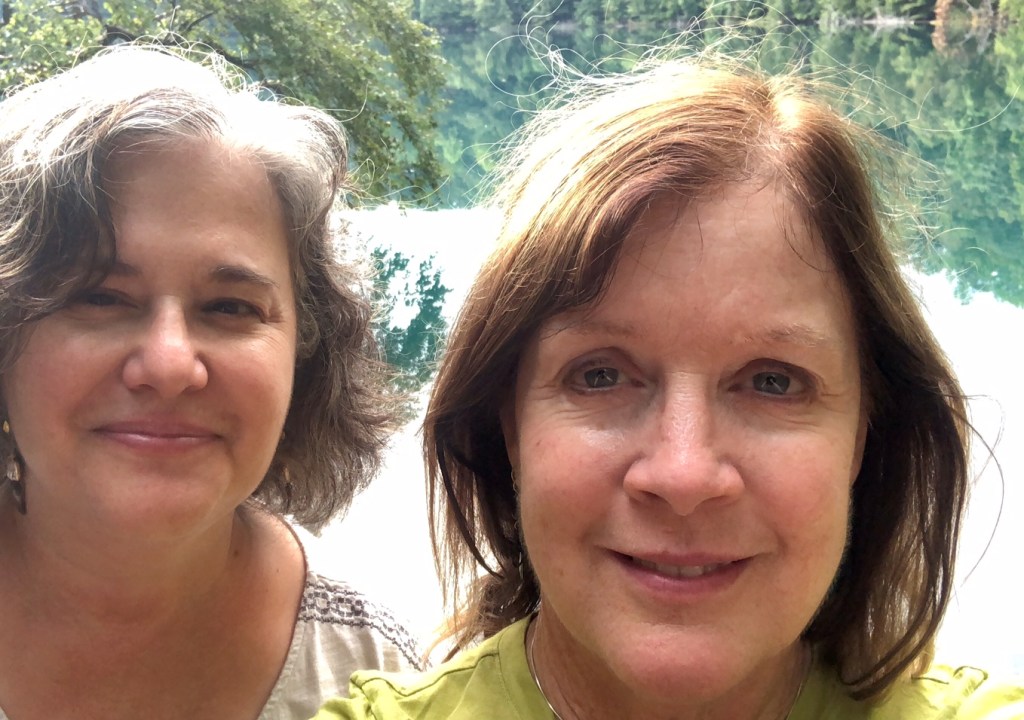
      A few times a year, I travel home to visit family and friends in Upstate, N.Y.  A long time ago, a tradition developed between one of my dearest friends and me. We walk the path around Green and Round Lakes near where we grew up. There’s something about walking a wooded path alongside pristine water that makes words flow, especially when your companion requires no explanation of your ramblings and doesn’t judge your craziest thoughts. By the time our trek reaches the more secluded Round Lake, we are compelled to pause and look in unison at the still water and the trees reflected on its surface. I know I can speak for both of us when I say this is a moment of reverence — broken only when one of us decides we need yet another “selfie.” 

      Surrounded by old-growth forest, Green and Round Lakes are two of only a few lakes in the world deemed “meromictic,” meaning there is no seasonal mixing of the upper and lower water levels as with other lakes. These glacially-carved lakes are deep and stable: Green Lake is 195 feet deep and Round Lake is 180 feet deep. The unusual features of these lakes create an otherworldly aquamarine color to the water. Growing up in this area, I took this beauty for granted. 

      I know that there were also times that I took my friendships for granted. Many years ago, I received a card that said: “The only way to have a friend is to be one.” It’s worth it to hold these words close and to live by them. Our old friends will be with us long after our parents have gone — they are a rare treasure, deserving careful attention. It seems fitting that Round Lake, a rare place, is the scene of my rendezvous with my old friend. 

      Share this:

      • Tweet
      Like Loading...
      Posted in poetry, Uncategorized, writing | 0 Comments | Tagged Friendship, GreenLakes, poetry, Walking, writing
    • Hymn for Agnostics

      Posted at 12:41 am by Ellen Austin-Li, on August 25, 2019

      Share this:

      • Tweet
      Like Loading...
      Posted in alcoholism/addiction, poetry, recovery, writing | 0 Comments | Tagged Agnostics, higher power, prayer
    • Hymn for Agnostics

      Posted at 12:39 am by Ellen Austin-Li, on August 25, 2019
       Hymn

      We must have our own version of a higher power.
      I find mine in the silence of snowflakes
      hushing over a city,
      or a divine moment like entering into fragrant woods
      stippled by sunlight.
      I, too, crave rain,
      when the mist kisses my skin,
      until I feel bathed like a newborn baby.
      I’m a sinner willing
      to be baptized again by a new God,
      tears couched in raindrops.
      Other times, sun’s heat penetrates me,
      cicadas buzz like electric currents in the air,
      energy jolting, or better put, power resurging,
      singing a hymn that I am 
      not a low hum but, 
      oh, so much more luminous
      than I once believed.  

      -inspired by Jeanne Wagner’s “Fanlight” 

      This poem is for people like me, who no longer (or perhaps never did) have an unshakable belief in God. Specifically, the “Capital G” God of organized religion. I was raised Roman Catholic, but my faith was chipped away by religious dogma. I mean no offense to anyone who follows this, or any other, faith tradition. A part of me feels envious of those who live with such certainty. I know that this is the definition of faith, this belief in something unknowable, but I simply do not possess it. Lack of faith presents a problem for those of us who realize that following a spiritual path is our only hope for recovery from a self-centered disease like alcoholism and/or addiction. 

      I find my proof of a higher power, if not a specific God, in the beauty of the natural world. How can we not help but wonder at the mystery we sense when we wander outside? It’s late August, and the tiny green berries on the “Beauty Berry Bush” have begun to turn purple; the invisible hands of its internal clock move mysteriously towards Fall. I recently saw a hummingbird visit the bright red blooms of the lantanas in my flower pots, sipping nectar from dozens of clusters as it hovered, its wings beating so fast they were nearly indistinguishable. The cicadas rip like buzz-saws all day long and then hand the baton to the crickets when the sun sinks. At night, when the crickets chorus so loudly, most of us don’t think to wonder about it at all— but, there must be millions of crickets chirping to generate this cacophony. (And did you know that only the male crickets are able to chirp, all in an effort to woo females?)

      I don’t have to sit in a church pew to know there is spiritual energy in the universe. For me, these small miracles are enough to bring me peace. 

      In the throes of my disease, I felt both worthless and hopeless, but this is no longer the truth. Today, I am free to be present for these moments in the everyday. When I notice the patterns and the beauty in nature, I am aware of the space I occupy — I’m part of this world, no more, no less. This is my hymn — I hope it helps others to find their own.  

      Share this:

      • Tweet
      Like Loading...
      Posted in alcoholism/addiction, poetry, recovery, writing | 2 Comments | Tagged Agnostics, higher power, prayer, recovery
    • Awakening

      Posted at 6:29 pm by Ellen Austin-Li, on July 27, 2019

      Share this:

      • Tweet
      Like Loading...
      Posted in alcoholism/addiction, poetry, recovery, writing | 0 Comments | Tagged spiritual awakening, spiritual experience, spirituality
    • Awakening

      Posted at 4:36 pm by Ellen Austin-Li, on July 27, 2019

      Awakening

      “This sense of clean and beautiful newness within and without is one of the commonest entries in conversion records…And that such a glorious transformation as this ought of necessity to be preceded by despair …”

                  -William James in The Varieties of Religious Experience           

      Without ghost lines of turned-down pages,
      I pulled the unread book from its wedged perch,
      opened to a tale written by a drunk sage.
      Without ghost lines, no turned-down pages,
      I unlocked the door of my cage —
      from weathered story sprung the answer to my search.
      Without ghost lines of turned-down pages,
      I awakened in this printed church.


      Although told in a deliberately obscure way, this poem, midway through my poetry collection, Firefly, marks a turning point in the story of my recovery from alcoholism and addiction. Within the lines of this poem, I sketch the spiritual experience that changed me.

      Alcoholics and addicts do not often experience a sudden upheaval in our way of thinking — most seem to have a gradual reordering based on learning how to live sober. I feel fortunate to have experienced a dramatic, unexplainable moment that filled me with light. I don’t see this as a mark of me being “special,” but rather as the universe gifting me with the only thing that could break through my intractable desperation.

      This poem went through several iterations until I settled on an old form, the French Triolet. The Triolet, which means “clover leaf” in Middle French, is a medieval verse from the thirteenth century. Enlish poets began using this form in the eighteenth century. The age of this poetic form, with its repeating lines and tight rhyme scheme, felt like an echo of all the people who came before me who had also received this spiritual gift.

      My awakening came at a moment when I was certain to lose my family, my husband and young son, if I drank again. Earlier that day, I carted all of the booze at home over to my in-laws’, but I was in the house, alone. It occurred to me that I could easily drive to the store and buy more alcohol. I knew I could lose everything if I did this, but I felt certain that I would drink. I shook with both fear and desire. Not knowing what else to do, I called a sober friend, a woman who had become my mentor. She asked if she could return my call in twenty minutes. Twenty minutes! That was so long. How could I stop this overwhelming urge to drink?

      I paced in my bedroom, looking at the clock; its digital numbers seemed frozen in place. The fear that I would drink consumed me. My twisted brain whispered, only a drink will relieve this fear — this fear that I would drink! (only an addict understands this logic). Finally, desperate to forestall my impulse, I picked a book about recovery, one I owned but had never read, off the bookshelf. I opened to a story written by a drunk. Within these pages, something changed inside my brain. It was more than merely recognizing myself in someone else’s story: the knowledge that I suffered from a spiritual disease became clear to me. Alcohol and drugs were substances I used to fill the void in my soul. That was what was wrong with me! I had a soul-sickness and it could be treated. This man had gotten better and so could I.

      By the time Sharon called me back, minutes later, I was utterly changed. Breathless and giddy, I asked her: Have you ever read this story? Do you know about what happened to this man?

      Well-acquainted with this famous story, Sharon merely laughed.

      And so, my journey towards recovery began.

      Share this:

      • Tweet
      Like Loading...
      Posted in Uncategorized | 2 Comments
    • Special Exhibit (at Ragnar Kjartansson’s Video Installation, “The Visitors”) — Ellen Austin-Li

      Posted at 6:18 pm by Ellen Austin-Li, on March 8, 2019

      A recent publication

      masque&spectacle's avatarMasque & Spectacle

      I have been on a string of so many days
      hung low. The truth is I am
      often tired of being alive, of daylight
      streaming through the translucent glass
      of my body, my virgin rebirth, discarded
      diamonds. I am the water in fountains
      people dance past.

      These days weave together
      on a loom, an unfinished tapestry
      with a repeating pattern: spoiled wool,
      dank, with rare flashes of gold.
      The truth is I am often tired
      of being alive, though I know this mantle
      can unravel with a pull on a thread.

      I trudged up concrete steps
      into the Art Museum, muscles sobbing
      with repetition, this desire to rise
      above the carved marble of my heart
      pushing me inside another air-conditioned
      hallway, where winged statuaries ushered
      me up, up, up, hushed

      into the darkened gallery. Shush,
      whispered metal brush on cymbals,
      the drummer on one screen of nine,
      each in a…

      View original post 280 more words

      Share this:

      • Tweet
      Like Loading...
      Posted in Uncategorized | 0 Comments
    • On Writing “Wild Hive”

      Posted at 6:49 pm by Ellen Austin-Li, on February 21, 2019
      Wild Hive

      A rumble summoned my husband last Spring
      to rescue a beehive; he found it
      hung like a tongue abuzz with hunger,
      urgent hooligans hunkering around
      a honeyed crux. He clipped the bunched
      cluster, curried the tree branch, and dumped
      it into a hovel.

      He had three hives at the beginning
      of winter, but only the mined line
      survived this time. He thinks

                          there’s something in being wild 
                          that keeps things alive

      *"Wild Hive" was published in Pine Mountain Sand & Gravel, Fall 2018.

      “Wild Hive” is the first poem in my poetry collection, Firefly. This book is an unfolding redemption story, as it paints the picture of my descent into alcoholism and addiction, as well as my struggle to live sober. I hope that “Wild Hive” introduces the reader to the sense of the bewilderment that permeates the mind of an addict. How did I get here? Why am I still alive? If it is my wild nature that helped me survive, what does it mean?

      My husband has been a beekeeper, an apiarist, for several years now. He possesses the mind of a scientist, so he studied all of the latest information on beekeeping; he has become quite the expert on all things related to honeybees. His enthusiasm has infected me as well. I have become as invested in the survival of our hives as he has—well, almost as invested. I’m sure the person who actually does the work of a beekeeper is the one most attached to the outcome.

      Two years ago this Spring, a couple who are good friends of ours called my husband. A swarm of honeybees had gathered in a tree near their home. Swarms occur for reproductive reasons; a queen bee leaves her hive, taking a number of workers with her, to form a new colony. Our friends had learned, probably from my husband, that it’s best to call a beekeeper to come and retrieve a swarm for their own hive collection rather than call an exterminator. With the honeybee population in decline, we need to respond to swarms in a way that protects them. So, off went my husband, garbed in his netted hat, to rescue his first swarm.

      The rescue unfolded just as described in the first stanza of “Wild Hive:” he clipped off the tree branch on which the swarm had clustered, dropped it into a cardboard box, and brought it home. At home, he used his smoker, an aluminum can that bears a striking resemblance to the Tin Man’s oil can in “The Wizard of Oz,” to blow smoke at the bees. The smoke masks the alarm pheromones of the bees, allowing a beekeeper to work around the hive without getting stung; in effect, the smoke stuns the bees into submission. In this way, my husband was able to get the wild bees settled into their new home.

      This “wild hive,” meaning a hive that was not cultivated for sale to beekeepers (yes, there is such a thing), but was instead formed in the wild, thrived. At that point, the wild hive constituted my husband’s third hive; they were safely ensconced in their own set of hive boxes.

      Most hives are lost over the winter months. Several theories have been posited on the causes of colony collapse disorder, such as the widespread use of pesticides, climate change, or mite infestation; most likely, it is a confluence of factors. When springtime arrives, beekeepers assess their losses—my husband has lost most of his hives each winter and needs to begin again with new bees each spring. The springtime following the first winter of the wild hive heralded a big surprise: the only hive of the three that made it through the winter was the rescued hive. Not only had it survived, but it had flourished.

      When my husband reported this news to me, I asked him why he thought the rescued swarm had made it through the winter when his other, more established, hives had not. He shrugged his shoulders and offered this considered response:  “Maybe there’s something about being wild that keeps things alive.”

      This comment resonated deeply with me; it incubated in my mind for several months, almost like the bees themselves, looking for a place to colonize. In a poetry workshop, the words of this poem spilled onto the page fully formed, as if they had been there all along. In this workshop, the facilitator read William Blake’s “The Tyger”—he prompted us to write a poem or an essay using sound in an inventive way. In one of those too-rare moments of poetic inspiration, this poem wrote itself.

      So, why did the words my husband had planted months before worm their way into my subconscious? For me, this message, which appears in the last two lines of ”Wild Hive,” voices what I have often wondered: how is it that I am still alive, given my wild past when I was blackout drinking and using drugs? At 20, I crashed my car while driving drunk into a barn on the side of the road. The accident happened in the middle of the night on a back-country road. We were lucky that another car happened upon us— my ex-boyfriend crawling along the side of the road with a shattered back; me, bleeding internally, pinned behind the steering wheel.  Unfortunately, there were many more years of risky behavior while drinking and using drugs. I did not get sober until over forty more years had passed.

      Why did I survive? It is unknowable, but it is a common question in the human condition. Why does one person live through a series of traumatic events while another dies young, having lived a short, blameless life? “Wild Hive” is not meant to posit an answer to this complex question, but instead reflect the seeming randomness of mortality. During the peaks of my disease, when I was filled with self-loathing, I didn’t want to continue living. I was too entrenched in the hopelessness of addiction to see a way out. I am grateful that I am now sober—on a good day, I see how my experiences may help another to recover. That is the meaning that I attach to my own survival; that is the way I make sense of this question.

      Share this:

      • Tweet
      Like Loading...
      Posted in alcoholism/addiction, poetry, publishing, recovery, Uncategorized, writing | 0 Comments
    ← Older posts
    Newer posts →
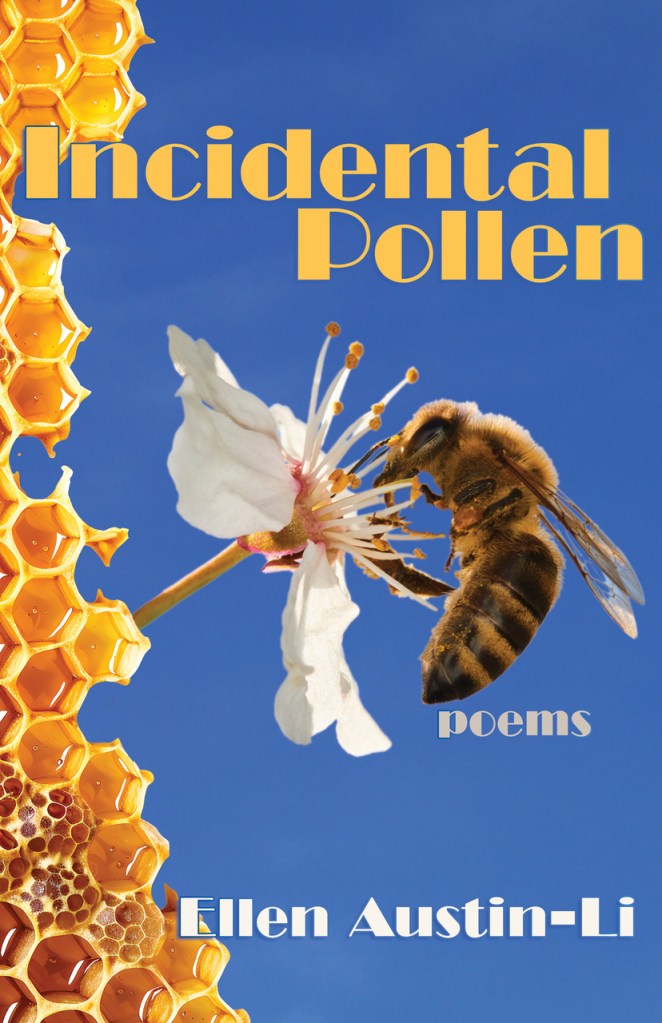
    • Publication date May 21st, 2025. Click on image to order from Madville Publishing.
    • Books

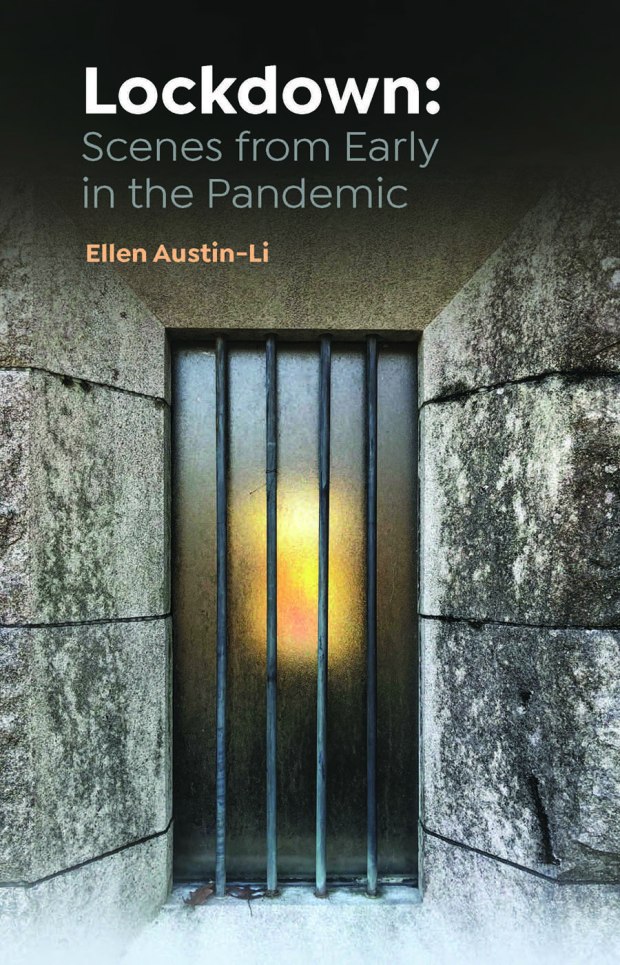
      Publication date: August 6th, 2021. Click on image for Finishing Line Press's bookstore

    • Books

      artwork by Elaine Olund @ EEO Design

      Firefly is available for sale at Finishing Line Press or at Amazon.com

    • Blog Posts


  • Unknown's avatar

  • Tags

    Agnostics alcoholism/addiction book-review books cilmate change Covid19 creative-writing Friendship GreenLakes higher power Ireland literature Living with Fear loss MFA programs nature November election poem poetry prayer publishing racial justice reading recovery shame spiritual awakening spiritual experience spirituality Walking writing
  • Follow Ellen Austin-Li on WordPress.com
  • Follow Us

    • X
    • Instagram
    • Facebook
  • writing, publishing, poetry, alcoholism/addiction, recovery

    alcoholism/addiction poetry publishing recovery Uncategorized writing

Blog at WordPress.com.

  • Subscribe Subscribed
    • Ellen Austin-Li
    • Join 37 other subscribers
    • Already have a WordPress.com account? Log in now.
    • Ellen Austin-Li
    • Subscribe Subscribed
    • Sign up
    • Log in
    • Report this content
    • View site in Reader
    • Manage subscriptions
    • Collapse this bar
 

Loading Comments...
 

    %d