Ellen Austin-Li

poet and writer
Ellen Austin-Li
  • Home
  • Blog
  • Showcase
    • Poetry
    • Essays
    • Books
    • Select Journal Publications:
  • About
  • Events
  • Contact
  • Category: alcoholism/addiction

    • When Art Delivers Forgiveness

      Posted at 1:41 pm by Ellen Austin-Li, on March 20, 2021
      Adonis
      
      Maybe I didn’t really want to find you
      or I would have hugged closer to where it culminated
      forty-one years ago this past May in a crash
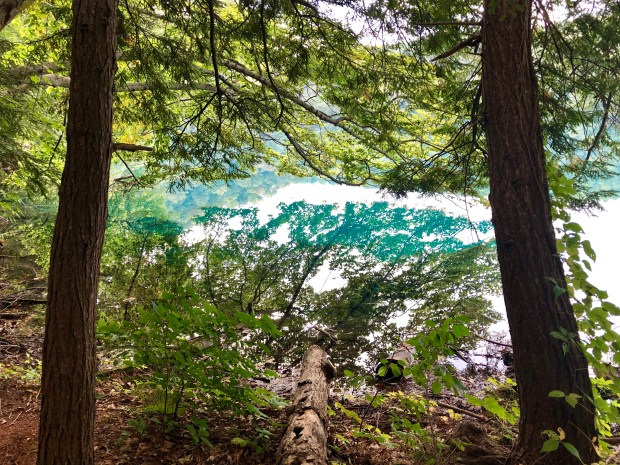
      on the way to Green Lakes      your home    of course it was 
      since the water in those rare lakes
      is the same turquoise as your eyes      like some god
      had poured the overflow of them into you
      I’ve been wanting to tell you 
      how sorry I’ve been for that night      I was behind
      the wheel when I couldn’t even navigate 
      a sentence    I remember it was our first evening out
      as ex-lovers but I knew I was in trouble
      the moment I saw you step out of your house
      and walk towards the Valiant        the sun hung low
      enough to catch your hair and spin it gold
      and ignite those eyes in the hottest blue flames
      and the great span of your shoulders stretched 
      beneath a white button-down shirt    you burned
      like Adonis come to call and there 
      was only one way I could answer     
      I ordered beer after beer at the bar 
      and I don’t know what happened next
      except my head hit the steering wheel so hard
      I didn’t open my eyes for three more days
      
                what the sight of you did to me    
                       
      I opened my email four decades later 
      and there you were       you said I suddenly hummed inside
      so you opened the internet and I spilled out
      you read the poems in my book      lines about you  
      I made the mistake of telling my mother     
      who at 92 recalled your name 
      as if it was back then with her accusing me
      of kissing you    our joined images   in the kitchen
      reflected on the polished wood door
      like it was something dirty she saw
      she never liked us together    she sensed
      our heat    how our hands always touched 
      each other’s bodies     one day
      she called me back into the house
      when my leg draped over yours
      while we sat on the front walk    love
      filthy love   desire and shame stained 
      in a way only buckets of booze could scrub clean 
      and this left you broken on the side of the road
      you said I don’t owe you amends      it’s enough 
      that no one died      now I see us 
      sitting on a tree trunk fallen by the shore
      our feet dangling in the cool green as we watch 
      our ripples meet on the surface.
      
      -published in Literary Accents, Vol.1, Issue 4, 2021


      When Art Delivers Forgiveness

      The most I’ve ever wanted from my poetry is to create empathy. Whether it’s by composing an image a reader recognizes or by witnessing human interactions, I wish to convey the truth that elevates the human experience. The best possible outcome is to stir a connection with a reader, to allow them to reflect on their own lives in every context, to see something of themselves, or gain an appreciation for another. 

      With my first poetry collection, Firefly, I wanted to witness my own experience with alcoholism and addiction as a way to tell others who suffer that recovery is possible. But, underneath that, I tried to tell my story to create empathy in the larger world for alcoholics and addicts. I thought if I could capture some of the nuances of living with this shadow—the crippling self-doubt, the denial, the shame—perhaps I could open a space for those unafflicted to begin to understand this often misunderstood disease.  

      Never (“in a million years,” as we used to say) did I expect to hear from someone I had gravely injured during my drinking days. The poem I posted tells the story better than my prose can recount because, for me, the difficult-to-capture emotion shimmers between the lines with poetry. I don’t know if my first poetry collection accomplished my grand dual goals of creating hope and empathy for fellow alcoholics and addicts. If I only reached one, then baring my soul was worth it. But, I do know that publishing Firefly gave me something I never thought possible: forgiveness. 

      I don’t think I was fully aware of the shadow I had internalized and carried around for over forty years until I heard from the person I had harmed. I still struggle with the damage I have done. In recovery, we hear, “we do not regret the past nor wish to shut the door on it.” Intellectually, I know this concept concerns using our past experiences to help other people, but it can be challenging to embrace, especially when you have caused lasting bodily injury to someone else. The old part of me still says I don’t deserve forgiveness. I’ve been carrying this shadow for so long—I don’t know how to let it go. But, it doesn’t feel as heavy now that I’ve taken the shadow out into the light—art, specifically, poetry, allowed me to do that. I’m forever grateful to the generous soul who granted me forgiveness, so I can perhaps learn to forgive myself. Thank you. You know who you are. 
      Share this:

      • Tweet
      Like Loading...
      Posted in alcoholism/addiction, poetry, publishing, recovery | 0 Comments
    • Navigating Fear

      Posted at 9:41 pm by Ellen Austin-Li, on March 29, 2020
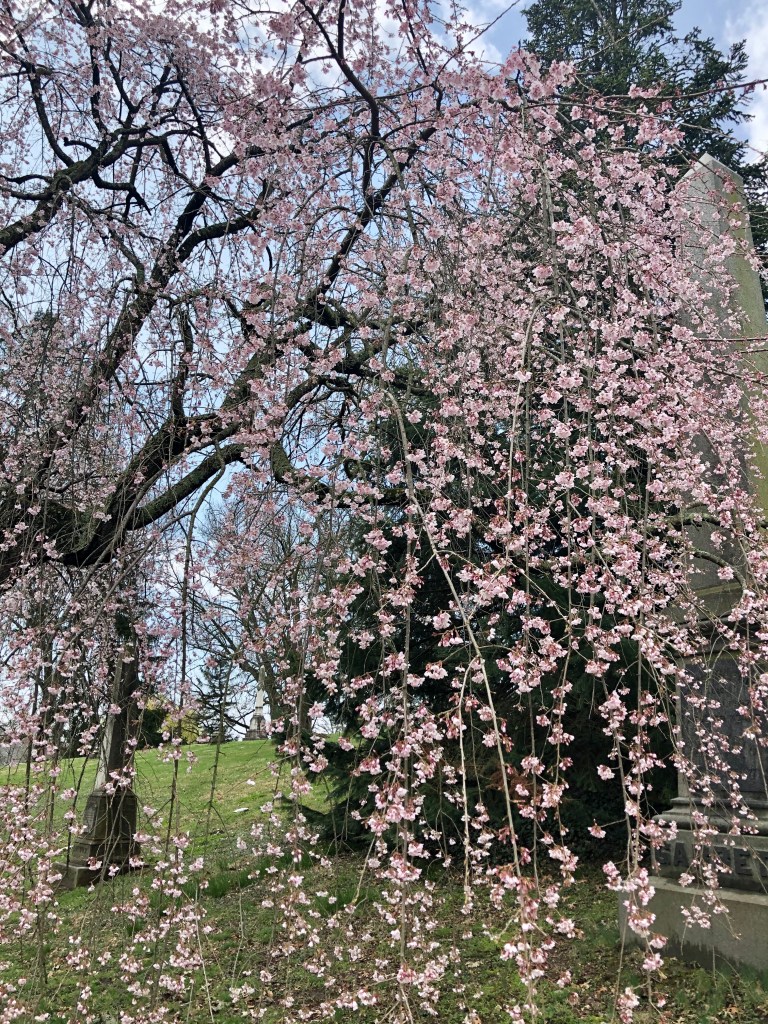
      Weeping Cherry in Spring Grove Cemetery, Cincinnati, Ohio

      “God, grant me the serenity to accept the things I cannot change, the courage to change the things I can, and the wisdom to know the difference.”

      Living through this pandemic, in a time of overwhelming fear, presents all of us with significant challenges. We, in the recovery community, have the opportunity to be of service to the world outside of our rooms (which currently happen to be virtual rooms on “Zoom”). We share the blessings of practice, sometimes years of practice, in navigating fear. We learn tools in recovery to help us live “life on life’s terms,” as we like to say, which helps us to stay sober. These same lessons can be applied by anyone who feels overwhelming fear, and that is the whole world right now.

      This writing isn’t to say that people in recovery no longer suffer from fear, or that we are immune to the same fear that others feel during this pandemic. Everyone is frightened right now — but, we have tools we can share with non-recovery folk, which may help get all of us to the other side.

      Has there ever been a better time to live by the Serenity Prayer? The first part of the Serenity Prayer reminds us that we need to accept what we cannot change. We have to accept the uncertainty of this time, as we do not have any control over how the Covid19 pandemic will unfold. I’ll admit, this has been a struggle for me, mainly because I have been stuck in anger directed at (my perception of) the federal government’s mismanagement of this crisis. Whether or not you agree with my political position is not essential — the point is, I cannot get to a place of acceptance, of serenity, if I allow resentment to take center stage. If I’m not the problem, there is no solution. I have to work on letting go of this anger. For me, that means praying for the people in the governmental institutions I am furious at right now to detoxify myself.

      For those of you who balk at the word “prayer,” let me assure you that I am not a religious person; I do, however, consider myself spiritual in that I believe there exists a power greater than myself. I’m an agnostic in recovery — and I know atheists, too — and I pray. Sometimes my prayer is as simple as please, give me the right words, or help X person do the right thing. I know from experience that prayer, over time, changes something in my brain. The circumstances that caused the resentment in the first place may not necessarily change, but I do. And that’s the name of the game: learning how to let go of overwhelming emotions that hinder your ability to not only cope with life, but to function.

      The next part in the Serenity Prayer, “the courage to change the things I can,” makes living with fear and uncertainty bearable. I can’t change the fact of this pandemic, but I can do my part to change what I can. I can decrease the chance of getting Covid19 by following the recommendations of health experts: practice social distancing, wash my hands frequently (for 20 seconds!), and not touch my face. These actions, in turn, help everyone else in the community by limiting the spread. I’m experiencing intense fear around the lack of PPE’s for healthcare workers, as I am married to one and have many working nurse friends (I’m a retired nurse). What can I do? I wish I knew how to sew, but I know people who do. I’ve shared information on social media about how to connect with organizations that are making masks. I’ve encouraged anyone with a stash of masks to consider a donation to their local hospital or nursing home. (Not all of your masks, as I understand the desire to have some for yourself, but there is info online about how to reuse masks for non-healthcare workers safely). That’s all I can do about PPEs, but it’s something.

      I can also be kind and loving within my own home, even though stress brings out the worst in all of us. I can apologize right away when I’ve said something hurtful and vow to myself to try to be better next time. It’s not about what other people say or do; it’s about what I say or do. I have control over my reactions in every interaction.

      The final part of the Serenity Prayer, “and the wisdom to know the difference,” tells us to look at and reevaluate our current responses. If I can’t get close to serenity, I know that I am probably confusing what I cannot change with what I can. The distinction isn’t as crucial as it is for me to stay in action mode. How I feel does not have the same consequences as what I do with these feelings. We are all fearful right now. We can take care of ourselves by acknowledging our fear but also by taking action — be it through prayer, walking, calling a friend (or a therapist, if needed), or practicing acts of kindness in our own homes. When we take care of ourselves, it ripples out towards others.

      Be safe, be well.

      Share this:

      • Tweet
      Like Loading...
      Posted in alcoholism/addiction, recovery, writing | 2 Comments | Tagged Covid19, Living with Fear
    • Hymn for Agnostics

      Posted at 12:41 am by Ellen Austin-Li, on August 25, 2019

      Share this:

      • Tweet
      Like Loading...
      Posted in alcoholism/addiction, poetry, recovery, writing | 0 Comments | Tagged Agnostics, higher power, prayer
    • Hymn for Agnostics

      Posted at 12:39 am by Ellen Austin-Li, on August 25, 2019
       Hymn

      We must have our own version of a higher power.
      I find mine in the silence of snowflakes
      hushing over a city,
      or a divine moment like entering into fragrant woods
      stippled by sunlight.
      I, too, crave rain,
      when the mist kisses my skin,
      until I feel bathed like a newborn baby.
      I’m a sinner willing
      to be baptized again by a new God,
      tears couched in raindrops.
      Other times, sun’s heat penetrates me,
      cicadas buzz like electric currents in the air,
      energy jolting, or better put, power resurging,
      singing a hymn that I am 
      not a low hum but, 
      oh, so much more luminous
      than I once believed.  

      -inspired by Jeanne Wagner’s “Fanlight” 

      This poem is for people like me, who no longer (or perhaps never did) have an unshakable belief in God. Specifically, the “Capital G” God of organized religion. I was raised Roman Catholic, but my faith was chipped away by religious dogma. I mean no offense to anyone who follows this, or any other, faith tradition. A part of me feels envious of those who live with such certainty. I know that this is the definition of faith, this belief in something unknowable, but I simply do not possess it. Lack of faith presents a problem for those of us who realize that following a spiritual path is our only hope for recovery from a self-centered disease like alcoholism and/or addiction. 

      I find my proof of a higher power, if not a specific God, in the beauty of the natural world. How can we not help but wonder at the mystery we sense when we wander outside? It’s late August, and the tiny green berries on the “Beauty Berry Bush” have begun to turn purple; the invisible hands of its internal clock move mysteriously towards Fall. I recently saw a hummingbird visit the bright red blooms of the lantanas in my flower pots, sipping nectar from dozens of clusters as it hovered, its wings beating so fast they were nearly indistinguishable. The cicadas rip like buzz-saws all day long and then hand the baton to the crickets when the sun sinks. At night, when the crickets chorus so loudly, most of us don’t think to wonder about it at all— but, there must be millions of crickets chirping to generate this cacophony. (And did you know that only the male crickets are able to chirp, all in an effort to woo females?)

      I don’t have to sit in a church pew to know there is spiritual energy in the universe. For me, these small miracles are enough to bring me peace. 

      In the throes of my disease, I felt both worthless and hopeless, but this is no longer the truth. Today, I am free to be present for these moments in the everyday. When I notice the patterns and the beauty in nature, I am aware of the space I occupy — I’m part of this world, no more, no less. This is my hymn — I hope it helps others to find their own.  

      Share this:

      • Tweet
      Like Loading...
      Posted in alcoholism/addiction, poetry, recovery, writing | 2 Comments | Tagged Agnostics, higher power, prayer, recovery
    • Awakening

      Posted at 6:29 pm by Ellen Austin-Li, on July 27, 2019

      Share this:

      • Tweet
      Like Loading...
      Posted in alcoholism/addiction, poetry, recovery, writing | 0 Comments | Tagged spiritual awakening, spiritual experience, spirituality
    • On Writing “Wild Hive”

      Posted at 6:49 pm by Ellen Austin-Li, on February 21, 2019
      Wild Hive

      A rumble summoned my husband last Spring
      to rescue a beehive; he found it
      hung like a tongue abuzz with hunger,
      urgent hooligans hunkering around
      a honeyed crux. He clipped the bunched
      cluster, curried the tree branch, and dumped
      it into a hovel.

      He had three hives at the beginning
      of winter, but only the mined line
      survived this time. He thinks

                          there’s something in being wild 
                          that keeps things alive

      *"Wild Hive" was published in Pine Mountain Sand & Gravel, Fall 2018.

      “Wild Hive” is the first poem in my poetry collection, Firefly. This book is an unfolding redemption story, as it paints the picture of my descent into alcoholism and addiction, as well as my struggle to live sober. I hope that “Wild Hive” introduces the reader to the sense of the bewilderment that permeates the mind of an addict. How did I get here? Why am I still alive? If it is my wild nature that helped me survive, what does it mean?

      My husband has been a beekeeper, an apiarist, for several years now. He possesses the mind of a scientist, so he studied all of the latest information on beekeeping; he has become quite the expert on all things related to honeybees. His enthusiasm has infected me as well. I have become as invested in the survival of our hives as he has—well, almost as invested. I’m sure the person who actually does the work of a beekeeper is the one most attached to the outcome.

      Two years ago this Spring, a couple who are good friends of ours called my husband. A swarm of honeybees had gathered in a tree near their home. Swarms occur for reproductive reasons; a queen bee leaves her hive, taking a number of workers with her, to form a new colony. Our friends had learned, probably from my husband, that it’s best to call a beekeeper to come and retrieve a swarm for their own hive collection rather than call an exterminator. With the honeybee population in decline, we need to respond to swarms in a way that protects them. So, off went my husband, garbed in his netted hat, to rescue his first swarm.

      The rescue unfolded just as described in the first stanza of “Wild Hive:” he clipped off the tree branch on which the swarm had clustered, dropped it into a cardboard box, and brought it home. At home, he used his smoker, an aluminum can that bears a striking resemblance to the Tin Man’s oil can in “The Wizard of Oz,” to blow smoke at the bees. The smoke masks the alarm pheromones of the bees, allowing a beekeeper to work around the hive without getting stung; in effect, the smoke stuns the bees into submission. In this way, my husband was able to get the wild bees settled into their new home.

      This “wild hive,” meaning a hive that was not cultivated for sale to beekeepers (yes, there is such a thing), but was instead formed in the wild, thrived. At that point, the wild hive constituted my husband’s third hive; they were safely ensconced in their own set of hive boxes.

      Most hives are lost over the winter months. Several theories have been posited on the causes of colony collapse disorder, such as the widespread use of pesticides, climate change, or mite infestation; most likely, it is a confluence of factors. When springtime arrives, beekeepers assess their losses—my husband has lost most of his hives each winter and needs to begin again with new bees each spring. The springtime following the first winter of the wild hive heralded a big surprise: the only hive of the three that made it through the winter was the rescued hive. Not only had it survived, but it had flourished.

      When my husband reported this news to me, I asked him why he thought the rescued swarm had made it through the winter when his other, more established, hives had not. He shrugged his shoulders and offered this considered response:  “Maybe there’s something about being wild that keeps things alive.”

      This comment resonated deeply with me; it incubated in my mind for several months, almost like the bees themselves, looking for a place to colonize. In a poetry workshop, the words of this poem spilled onto the page fully formed, as if they had been there all along. In this workshop, the facilitator read William Blake’s “The Tyger”—he prompted us to write a poem or an essay using sound in an inventive way. In one of those too-rare moments of poetic inspiration, this poem wrote itself.

      So, why did the words my husband had planted months before worm their way into my subconscious? For me, this message, which appears in the last two lines of ”Wild Hive,” voices what I have often wondered: how is it that I am still alive, given my wild past when I was blackout drinking and using drugs? At 20, I crashed my car while driving drunk into a barn on the side of the road. The accident happened in the middle of the night on a back-country road. We were lucky that another car happened upon us— my ex-boyfriend crawling along the side of the road with a shattered back; me, bleeding internally, pinned behind the steering wheel.  Unfortunately, there were many more years of risky behavior while drinking and using drugs. I did not get sober until over forty more years had passed.

      Why did I survive? It is unknowable, but it is a common question in the human condition. Why does one person live through a series of traumatic events while another dies young, having lived a short, blameless life? “Wild Hive” is not meant to posit an answer to this complex question, but instead reflect the seeming randomness of mortality. During the peaks of my disease, when I was filled with self-loathing, I didn’t want to continue living. I was too entrenched in the hopelessness of addiction to see a way out. I am grateful that I am now sober—on a good day, I see how my experiences may help another to recover. That is the meaning that I attach to my own survival; that is the way I make sense of this question.

      Share this:

      • Tweet
      Like Loading...
      Posted in alcoholism/addiction, poetry, publishing, recovery, Uncategorized, writing | 0 Comments
    • Author photo by Suz Fleming

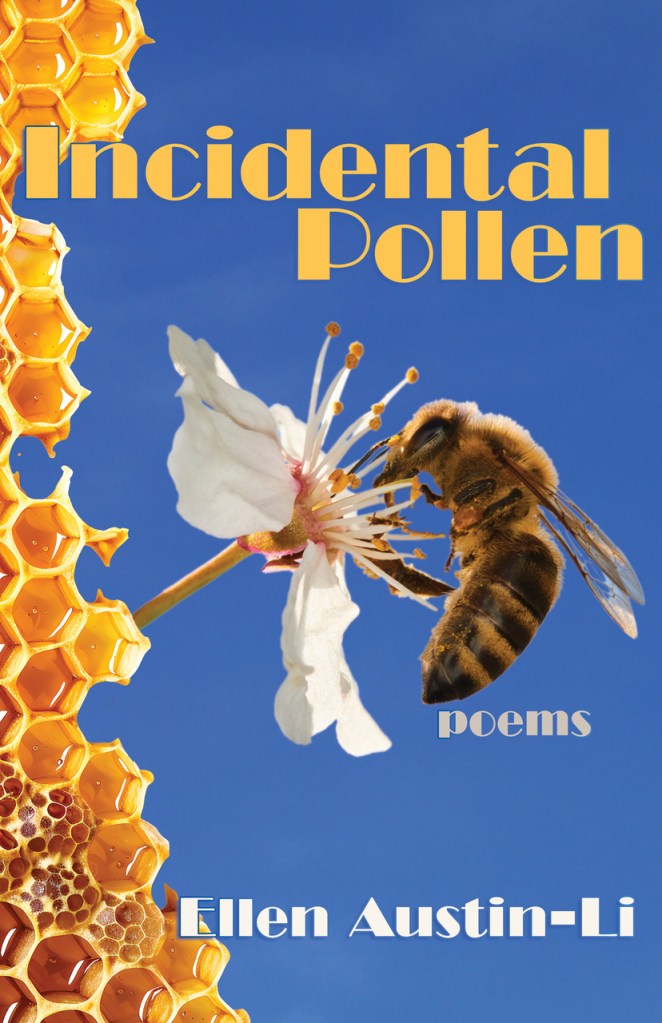
    • Publication date May 21st, 2025. Click on image to order from Madville Publishing.
    • Books

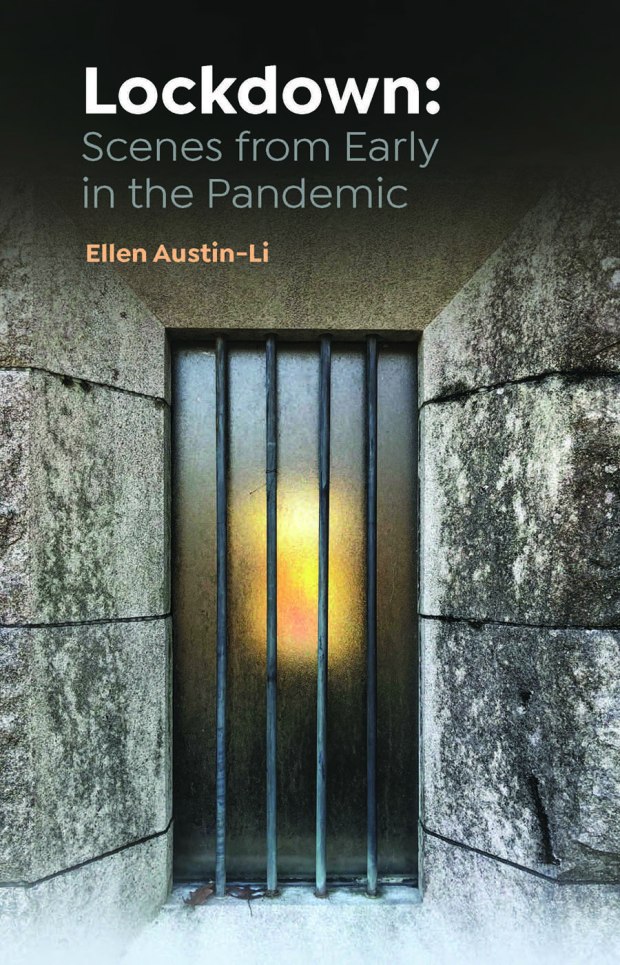
      Publication date: August 6th, 2021. Click on image for Finishing Line Press's bookstore

    • Books

      artwork by Elaine Olund @ EEO Design

      Firefly is available for sale at Finishing Line Press or at Amazon.com

    • Blog Posts


  • Unknown's avatar

  • Tags

    Agnostics alcoholism/addiction book-review books cilmate change Covid19 creative-writing Friendship GreenLakes higher power Ireland literature Living with Fear loss MFA programs nature November election poem poetry prayer publishing racial justice reading recovery shame spiritual awakening spiritual experience spirituality Walking writing
  • Follow Ellen Austin-Li on WordPress.com
  • Follow Us

    • X
    • Instagram
    • Facebook
  • writing, publishing, poetry, alcoholism/addiction, recovery

    alcoholism/addiction poetry publishing recovery Uncategorized writing

Blog at WordPress.com.

  • Subscribe Subscribed
    • Ellen Austin-Li
    • Join 37 other subscribers
    • Already have a WordPress.com account? Log in now.
    • Ellen Austin-Li
    • Subscribe Subscribed
    • Sign up
    • Log in
    • Report this content
    • View site in Reader
    • Manage subscriptions
    • Collapse this bar
 

Loading Comments...
 

    %d